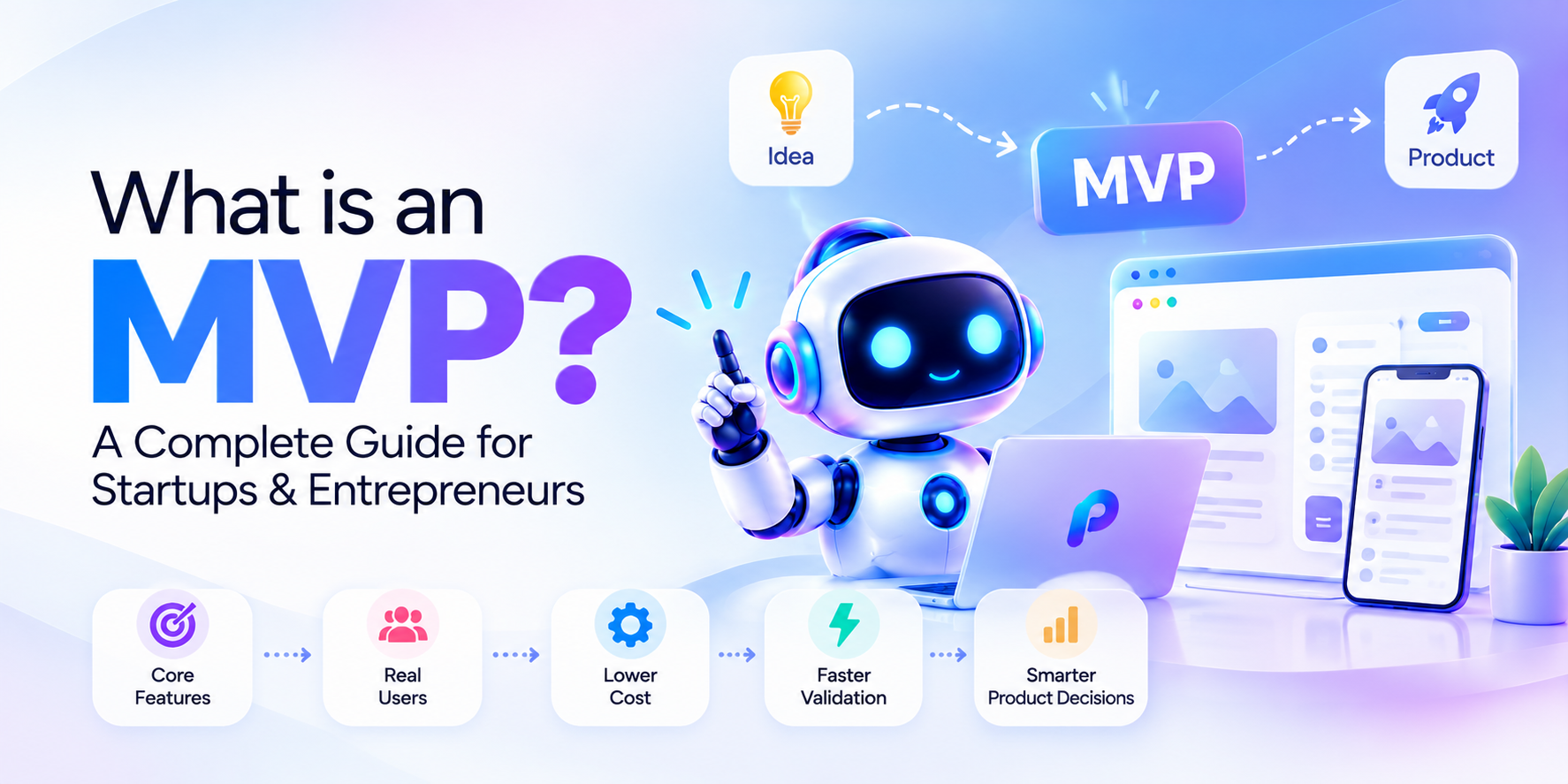
An MVP (minimum viable product) is the simplest version of a product that solves one main problem for a small group of early users. You launch it to learn whether people truly want it, before you spend more time and money on features nobody asked for.
Key takeaways
- An MVP is a test of demand, not a smaller copy of your full product.
- "Minimum" means the fewest features that solve one core problem. "Viable" means it works well enough to use.
- Dropbox, Airbnb, Zappos and Buffer all began with a simple test, not a finished product.
- You can plan an MVP in six steps, from one clear problem to a build-ready plan.
- A clear plan keeps your first build small, fast and focused.
What does MVP mean?
MVP stands for minimum viable product. It is the first version of a product that is small enough to build fast and useful enough to test with real people.
Definition: A minimum viable product (MVP) is the simplest version of a product that solves one core problem for early users and gives the team real feedback.
In business, MVP meaning comes down to three words. Minimum means only the features needed to solve one problem. Viable means it works well enough that someone gets real value. Product means people can actually use it.
Eric Ries popularized the term in his book The Lean Startup. He framed an MVP as the fastest way to learn what customers want.
Why does this matter? CB Insights, a market research firm, studied 431 venture-backed startups that shut down since 2023. Poor product-market fit was a cause in 43% of the 385 with known reasons (CB Insights, 2026). An MVP checks demand early, while changes are still cheap.
What are famous MVP examples?
Famous MVP examples show that a first version can be a video, a landing page or a hand-made service. None of these founders built the full product first.
| Company | First version | What they learned |
|---|---|---|
| Dropbox | A 3-minute demo video on Hacker News, plus a beta waiting list (2007) | Early adopters wanted it. A 2008 follow-up video grew the waiting list from 5,000 to 75,000 in one day. |
| Airbnb | A basic site and three air mattresses in the founders' apartment during a design conference (2007) | Three guests paid $80 each, so strangers would pay to stay in a home. |
| Zappos | Photos of shoes from local stores, posted online. The founder bought each pair after an order (1999) | Shoppers would order shoes online before the company owned any stock. |
| Buffer | A two-page site, then a pricing page added between them (2010) | Some visitors clicked paid plans, so the founder built the first version in 7 weeks. |
Sources: Drew Houston, Startup Lessons Learned; BI Norwegian Business School on Airbnb; Fortune, 2012; Joel Gascoigne, Buffer, 2011.
The pattern is clear. Each team tested its riskiest guess first: will people want this? Dropbox and Buffer needed almost no product code to find out. Zappos and Airbnb did it by hand.
Not sure what your first version should include? Get your MVP blueprint (features, user journeys, tech stack) free with Piltox, an AI startup idea validation platform.
What is an MVP not?
An MVP is not a buggy product, and it is not a full product with fewer pages. It is a focused test.
- Not a half-built product. Broken features hurt trust. A good MVP does a few things well.
- Not a feature dump. If you cannot name the one problem it solves, it is too big.
- Not a one-time launch. It is the first step in a build, measure and learn loop.
- Not a reason to skip research. Talk to users before and after you build.
- Not low quality. "Minimum" describes scope, not care.
- Not a guarantee. An MVP can show that nobody wants your idea. That is a good result, because you learned it cheaply.
How do you plan an MVP in 6 steps?
To plan an MVP, move from one clear problem to a build-ready plan. Here is how to build an MVP plan in six steps.
- Define the problem. Write one sentence: "[User] struggles with [problem] because [reason]." If you cannot, the idea is not ready.
- Pick your first user. Choose one narrow group, such as freelance designers, not "everyone." Talk to a handful of them to learn how they solve the problem today.
- Map the core journey. List the steps from first visit to solved problem. This is your user journey. Keep just one, because a second journey doubles the work.
- Cut features hard. List every idea, then keep only what the core journey needs. Move the rest to a "later" list.
- Choose how to build it. A landing page, clickable mockup, no-code tool or hand-run service can work. When you code, pick a stack your developer knows.
- Set a success metric. Decide what proves demand, such as 10 people paying, and write it down before launch so you cannot move the goalposts later.
Worked example (illustrative, not a real client): a booking app for local pet groomers.
| Plan piece | Example |
|---|---|
| User roles | Pet owner, groomer |
| Core journey | Find a groomer, pick a time, pay a deposit |
| Must-have features | Search, calendar, deposit payment, reminders |
| Later list | Reviews, loyalty points, mobile app |
| Tech stack idea | Next.js with Supabase, an open-source backend |
| Success metric | 10 paid bookings in the first month |
A Piltox blueprint builds this kind of plan from one conversation, then adds UI mockups and an HTML prototype.
What is the difference between an MVP, a prototype and a proof of concept?
A proof of concept shows an idea can work. A prototype shows how it will look and feel. An MVP lets real users try a working product.
| Aspect | Proof of concept | Prototype | MVP |
|---|---|---|---|
| Main question | Can we build this? | Do people understand the design? | Do people want and use it? |
| Used by | Your team | Test users and your team | Real early users |
| Working product? | Partly, often one feature | No, mostly screens | Yes, one core flow |
| Typical output | Technical test | Mockups or clickable demo | Live product or service |
Many teams build a prototype first, then an MVP. The prototype helps you agree on screens and flows. The MVP then tests whether people will actually use them. Piltox's AI UI mockups and HTML prototype fit that first step.
How long does it take to build an MVP?
It depends on scope. As a rule of thumb, a landing page test takes days, while a coded MVP takes weeks to a few months. Buffer's founder built his first version in 7 weeks, working evenings and weekends.
Five things drive the timeline:
- Number of features
- Platforms (web, iOS, Android)
- Integrations, such as payments
- Team size and experience
- How clear the plan is
A clear plan saves the most time because it stops scope from growing mid-build. Cutting one feature from the first version is almost always faster than adding one halfway through.
Ready to plan your first product?
Get your MVP blueprint (features, user journeys, tech stack) free and walk into development with a plan. Want a human view? Book a $9.99 expert session to scope your MVP.
MVP FAQs
What is the main goal of an MVP?
The main goal is learning. You want to find out whether a real group of people has the problem you think they have, and whether your solution helps. Revenue and polish come later. A good MVP gives you clear answers fast, so you can improve or change direction early.
Can you build an MVP without coding?
Yes. Many MVPs start with no code. You can use a landing page, a clickable mockup, a no-code tool or a service you run by hand, as Buffer and Zappos did early on. Code makes sense once you know people want the product.
How many features should an MVP have?
Only as many as the core user journey needs, usually a handful. List every idea, then keep what a user must have to solve the main problem. Everything else goes on a later list. If a feature does not help test your main guess, cut it.
What happens after you launch an MVP?
You measure, listen and decide. Check your success metric, talk to users and see where they drop off. Then choose to improve the product, change direction or stop. This build, measure and learn loop repeats until the product fits a real market.
How is an MVP different from a finished product?
A finished product aims to serve a whole market with many features and polish. An MVP serves a small group with one core feature set. You build it to test demand and gather feedback, then add to it based on what real users do, not on guesses.