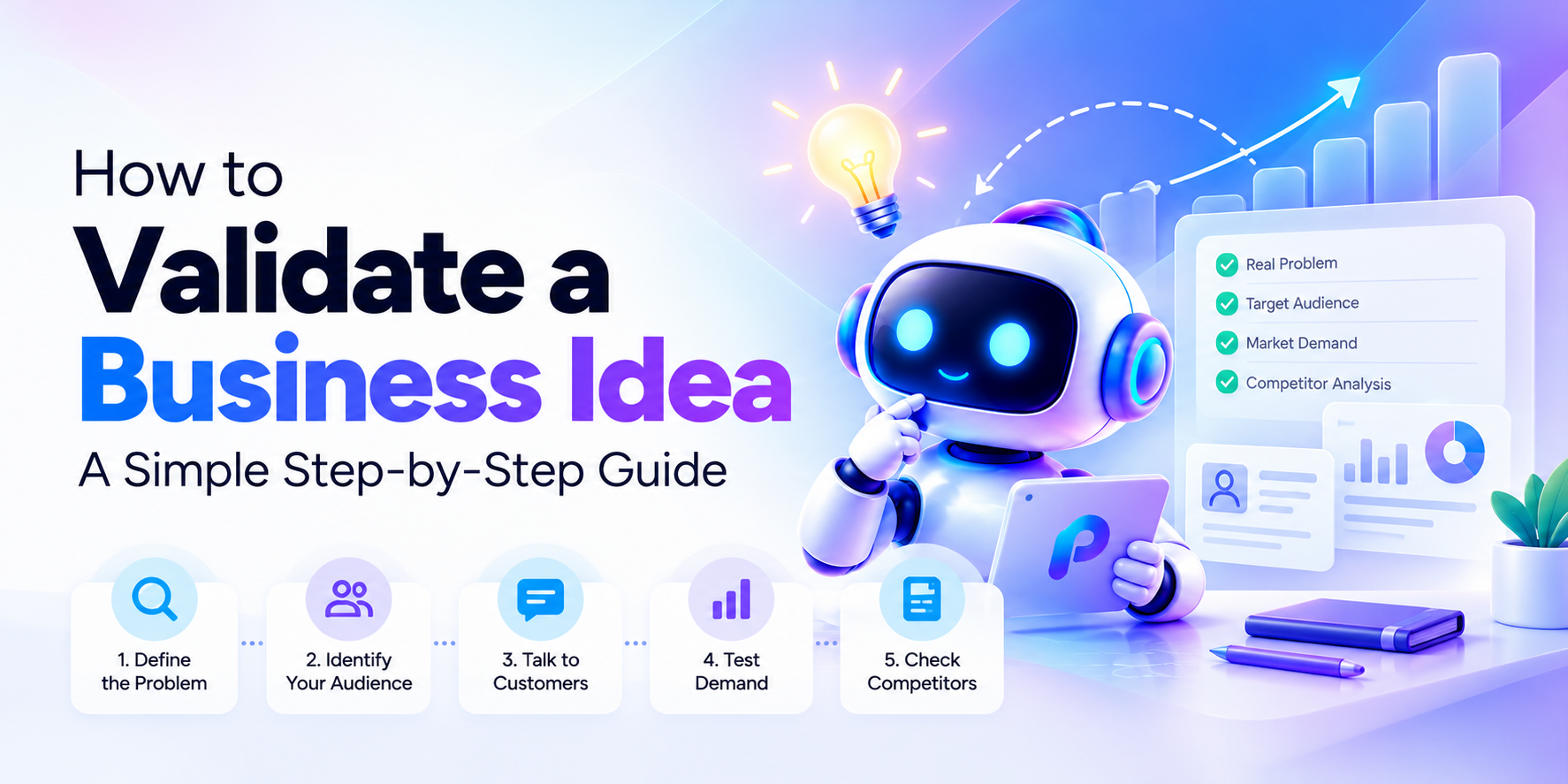
Validate a business idea by confirming a real problem exists, identifying who has it, talking to potential customers, testing demand with a simple offer or landing page, and checking competitors and pricing before you build anything. The goal is proof that people will pay, not just praise for the idea.
Key takeaways
- Business idea validation means collecting evidence that real people have a problem and will pay to solve it.
- Start with the problem, not the product. If you can't write it in one sentence, you're not ready to build.
- Ask potential customers about what they did in the past, not whether they like your idea.
- Sign-ups, deposits and pre-orders are stronger proof than compliments.
- Most ideas can be tested in a few weeks for little or no money.
What does it mean to validate a business idea?
Validating a business idea means testing whether a real group of people has the problem you want to solve, and will pay for a fix, before you build it. It swaps guesses for evidence.
Think of it as a cheap test before an expensive bet. You check the riskiest parts of your idea first: Is the problem real? Who has it? Will they pay? Who else is solving it?
This matters because building something people don't want is a common way to fail. In a March 2026 study of 431 venture-backed startups that shut down since 2023, CB Insights found that "43% named poor product-market fit as a root cause." Product-market fit means your product meets a strong need for a clear group of customers who will pay for it.
The risk isn't limited to startups. Data from the U.S. Bureau of Labor Statistics shows that only 51.4% of business establishments opened in the year to March 2020 were still open five years later.
Validation is not the same as asking friends if they like your idea. Good validation looks at what people do (sign up, pay, switch tools), not just what they say.
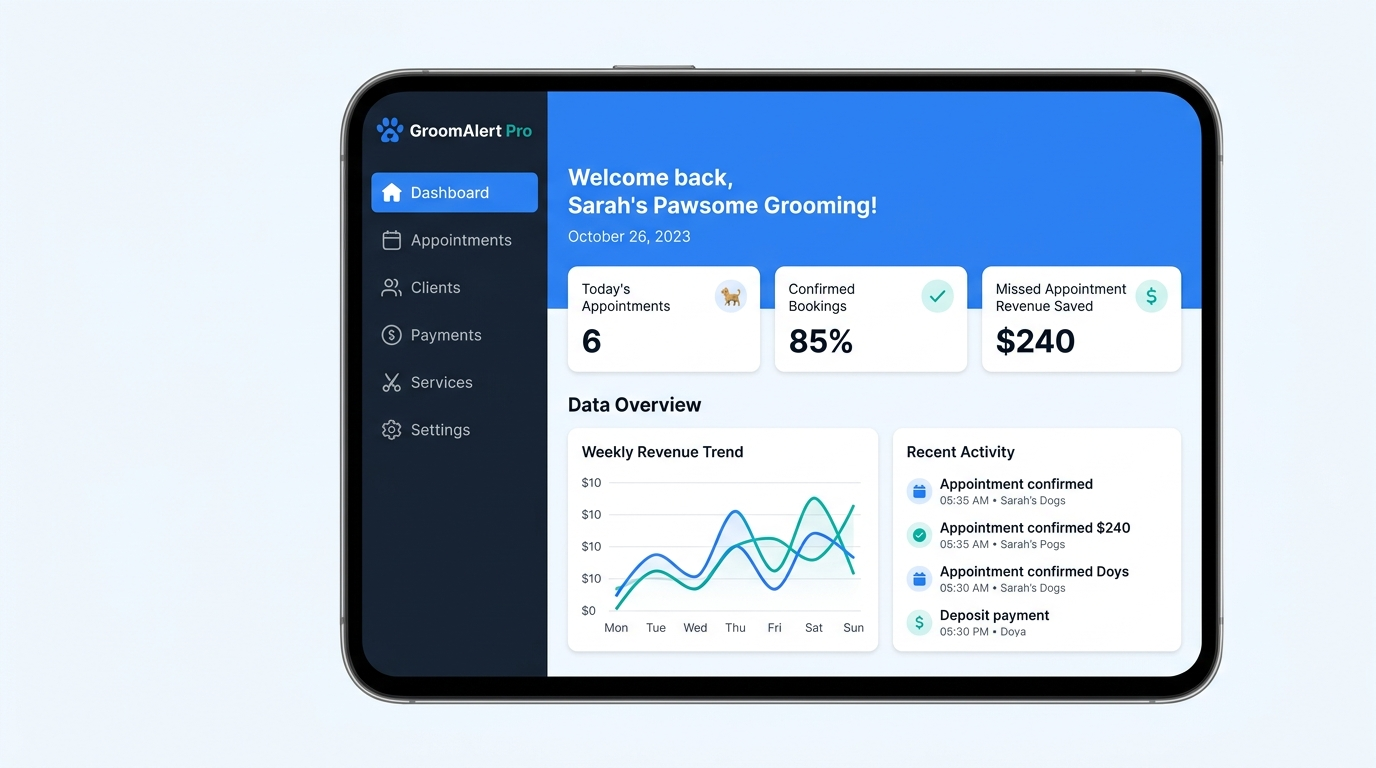
Our example idea (hypothetical): Maya wants to build an app that helps solo dog groomers stop losing money when clients miss appointments. We'll take her idea through all five steps below.
Step 1: Define the problem you're solving
Write the problem in one clear sentence, without mentioning your product. If you can't describe the problem, you can't test it.
A problem statement is a short sentence that says who struggles, with what, and what it costs them. Use this simple formula:
[Who] struggles to [task] because [reason], which costs them [time, money or stress].
Keep the focus on the pain, not your solution. "People need an app for invoices" is a solution in disguise. "Freelancers lose hours every month chasing late payments" is a problem.
Then ask three quick questions:
- How often does it happen? Daily problems beat yearly ones.
- How painful is it? Look for lost money, time or customers.
- Are people already trying to fix it? Workarounds are a great sign.
Example: Maya's first draft was "Groomers need a better booking app." That's a product, not a problem. Her rewrite: "Solo dog groomers lose income when clients miss appointments, because the empty slot is hard to fill at short notice." Now she has something she can test.
Step 2: Identify who has the problem
Narrow your idea down to one specific group of people who feel the problem most often and most painfully. "Everyone" is not a customer.
Start with your early adopters. Early adopters are the first people likely to try a new product, because the problem hurts them most and they're already looking for a fix.
Write a two-line profile that covers:
- Who they are: their job, business type or life situation.
- What they use today: the tools or workarounds they rely on now.
- Where they gather: online groups, forums, LinkedIn, events or local spots.
- Who pays: the user and the buyer are not always the same person.
If your profile could describe millions of people, it's too broad. A narrow group is easier to find, easier to talk to and easier to sell to.
Example: Maya started with "pet businesses." She narrowed it to mobile and home-based dog groomers who work alone and take bookings by phone or text. They feel no-shows the most, because there's no front desk to refill a slot. She can find them in grooming Facebook groups and local business listings.
Step 3: Talk to potential customers
Have short, honest conversations with 10 to 15 people from your target group, and ask about their past behavior, not your idea. You're there to learn, not to pitch.
A customer interview is a 15 to 30 minute conversation where you learn how someone deals with a problem today. The hard part is that people are polite. If you ask "Would you use this?", most will say yes to be nice.
Rob Fitzpatrick's book The Mom Test is built around this problem: how to learn if your business is a good idea "when everyone is lying to you." The fix is to ask about real past events, which are hard to fake.
| Ask this | Not this |
|---|---|
| Tell me about the last time this happened. | Would you use an app that fixes this? |
| What did you do about it? | Do you think this is a good idea? |
| What does it cost you when it happens? | How much would you pay for this? |
| What have you already tried? | Would you buy this if I built it? |
Listen for specific stories, money or time already spent, and homemade workarounds. Vague answers like "Yeah, that'd be cool" are a warning sign.
Example: Maya spoke to 12 groomers. Most could describe a recent no-show in detail. Several were sending reminder texts by hand every evening. Two had started asking for deposits but found chasing them awkward. That's real pain, a current workaround and a hint that they'd pay for a fix.
Step 4: Test demand before you build
Put a simple offer in front of real people and see if they act on it, by joining a waitlist, paying a deposit or pre-ordering. Actions are the clearest proof of demand.
You don't need a finished product for this. A minimum viable product (MVP) is the simplest version of your product that lets you test your idea with real users. Often, you can test demand with even less:
| Test | What it is | What it proves |
|---|---|---|
| Landing page test | A one-page website that explains your offer and asks visitors to sign up | Interest |
| Pre-sale or deposit | People pay now for early access | Willingness to pay |
| Concierge test | You deliver the service by hand to a few customers | Value of the result |
| Clickable prototype | Mock screens people can tap through | Whether the solution makes sense |
Before you launch, set a clear success goal, such as a number of sign-ups or deposits. Decide it in advance, so you can't move the goalposts later.
Example: Maya built a one-page site: "Automatic reminders and deposits for solo groomers." She shared it in three groomer groups and with everyone she interviewed. Her two-week goal was 40 waitlist sign-ups and 5 paid early-access spots. She hit the sign-up goal but got only 3 deposits. So she went back to ask the others what held them back.
Want a head start on your test? Piltox, an AI startup idea validation platform, turns one conversation about your idea into a product blueprint. It covers your problem statement, target audience, core features, user journeys and a recommended tech stack. You can also create UI mockups and a clickable HTML prototype to show people in interviews. Run your idea through Piltox and get a free blueprint.
Step 5: Check competitors and pricing
Find out who already solves this problem and what they charge. Competitors are usually a good sign, because they prove people pay for a solution. Your job is to find the gap.
Look at three kinds of competition:
- Direct competitors: products that solve the same problem for the same people.
- Indirect competitors: other ways people handle it today, like spreadsheets, paper diaries or hiring help.
- Doing nothing: often your biggest rival. If the problem is easy to ignore, people will ignore it.
| What to check | Where to look | What it tells you |
|---|---|---|
| Who solves this today | Google, app stores, your interviews | How crowded the market is |
| What they charge | Competitor pricing pages | The price range buyers accept |
| What users complain about | 2 and 3 star reviews, forums | Gaps you could fill |
| How they find customers | Their ads, social posts and search results | Channels you could use |
Example: Maya found several booking tools that already send reminders. But most of the groomers she interviewed said the tools they'd tried felt built for bigger salons with front-desk staff. Her angle became a simpler, lower-priced tool made only for solo groomers, with deposits built in.
Your business idea validation checklist
Copy this list and work through it this week. Each item maps to one of the five steps above.
- Write your problem in one sentence, with no product words.
- Describe your target customer in two lines.
- List three places where these people gather, online or offline.
- Book 10 customer conversations (strangers, not friends).
- Ask about the last time the problem happened, not about your idea.
- Note every workaround and cost you hear.
- Set a success goal for sign-ups or deposits.
- Launch a one-page landing page or pre-sale offer.
- List three direct and three indirect competitors, with prices.
- Decide: go ahead, change direction or stop.
How long does validation take?
Most first-time founders can work through the idea validation process in two to six weeks, part-time. The biggest factor is how easy your customers are to reach.
Here's a rough guide for each step:
| Step | Rough time (part-time) | What you'll have at the end |
|---|---|---|
| 1. Define the problem | 1 to 2 days | A one-sentence problem statement |
| 2. Identify who has it | 2 to 3 days | A customer profile and where to find them |
| 3. Talk to customers | 1 to 2 weeks | Notes from 10 or more interviews |
| 4. Test demand | 1 to 2 weeks | Sign-ups or deposits measured against your goal |
| 5. Check competitors and pricing | 2 to 3 days (can run alongside Step 3) | A competitor list and price range |
Selling to businesses usually takes longer than selling to consumers, because decision-makers are harder to book. Validation also never fully ends. You keep testing as you build, and a pivot (a change of direction based on what you learned) is a normal result, not a failure.
Common validation mistakes
The most common mistake is treating kind words as proof. Watch out for these six traps:
- Asking friends and family. They want to support you, so their feedback is too kind. Talk to strangers who have the problem.
- Pitching instead of listening. If you talk more than half the time, you're selling, not learning.
- Counting compliments as demand. "I love it!" is not a sign-up, a deposit or a sale.
- Targeting everyone. A broad audience gives mixed answers. Pick one group first.
- Building first. Spending months on an app before one customer conversation is the costliest way to test an idea.
- Skipping a success goal. Without a target set in advance, any result can look like a win.
FAQs
How do I validate a business idea with no money?
Most validation costs time, not money. Find potential customers in free online groups, on LinkedIn or through your network, and talk to them. Then test demand with a free landing page builder or sign-up form, and share it where your audience spends time. A small refundable deposit is a cheap way to test willingness to pay.
How many customer interviews do I need?
Aim for 10 to 15 conversations with people from one specific target group. By then, you'll usually hear the same problems and workarounds come up again and again. If the answers are still all over the place after 15 interviews, your target group is probably too broad. Narrow it and talk to a few more people.
What is the difference between validating an idea and building an MVP?
Validation tests whether the problem and the demand are real. An MVP, or minimum viable product, is the simplest working version of your product, built to test whether your solution works. Validate first, then build the MVP. Skipping straight to the MVP can mean months spent building something nobody asked for.
Can AI help you validate a business idea?
Yes, AI can speed up parts of the process. It can help you sharpen your problem statement, define your target audience, plan core features and create mockups to show in interviews. Piltox, for example, turns a conversation about your idea into a product blueprint. But AI can't replace real conversations and real sign-ups from customers.
What should I do if my idea fails validation?
Treat it as a win, because you just saved months of building. Look closely at what you learned. Maybe the problem is real but you picked the wrong customer group, or your price was too high. Change one thing and test again. If nobody cares about the problem at all, move on to your next idea.
Ready to validate your idea?
You don't need a big budget or a finished product to know if your idea is worth building. Start with the checklist above, and let Piltox do the planning work. Piltox asks the right questions about your idea and turns your answers into a build-ready blueprint you can export as a PDF and share.
Run your idea through Piltox and get a free blueprint. No credit card needed.
Sources
- CB Insights, "The top 9 reasons startups fail", March 5, 2026.
- U.S. Bureau of Labor Statistics, Business Employment Dynamics, "Table 7. Survival of private sector establishments by opening year", data through March 2025.
- Rob Fitzpatrick, The Mom Test.